Greetings from Carcassonne

“It is from their foes, not their friends, that cities learn the lesson of building high walls.”

When we were young, my cousin, brother and I used to play a computer game (CIV II) where one key element of military strategy was to build city walls. I know it sounds lame and weird, but this computer game had a (positive) lasting influence on my life — and I’m actually pretty sure my cousin and brother would say the same thing.

So when I heard there was a small French town completely surround by fortified city walls, I just had to stop for a visit.

None of the pictures I’ve taken would sum this place up more than one aerial shot that I found on the internet.

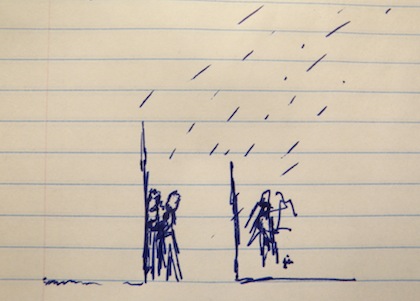
One evening it rained quite heavily, and I thought it was fantastic because there was something just absolutely medieval about the rain hitting the stone streets and walls.

 
Now, if you told me that there was a store that only sold white clothes and then you asked me which country that store was in, I would have guessed France. I would have been right.

It reminded me of a single plum floating in perfume served in a man’s hat.

plum.perfume.hat

Greetings from Figueres

I don’t know much about Salvador Dali, but seeing the museum he designed for himself, I can tell he was quite a prankster.

Yes, those are eggs, bread, baguettes and other foods all over the building.
 

Greetings from Barcelona

I’ve been in Barcelona for five days now with a few more to go.

I promised people I’d post photos along this trip, so I’ll try my hardest to do so.
 

· When I first saw this building (Casa Batllo), it was so beautiful that I almost cried. Almost.

· I couldn’t get any nice pictures of it, and there are none on the internet. It’s actually kinda sad.

· My other favourite place is the Magic Fountain of Montjuïc. I know you might think it’s just a fountain, but…it’s just — what can I say? — majestic.

· and then I got to see one of the things I wanted to see most: a real, live Spanish protest against the banks!

· I’ve also been writing my final research paper, and the cafes provide a conducive atmosphere

· I cannot describe to you how difficult it is to travel and be vegetarian.

· the only lowlight so far: seeing a Barcelona street fight, with whips and everything. not fun to watch, especially when you can’t do anything.

· there are so many other places and things, but I can’t post everything!

 
UPDATED (May 17, 2013):

· Barcelona is like a confused teenager that can’t decide whether it wants to grow up and be modern or stay an undeveloped child.

· My first touch of the Mediterranean

· la boqueria, where apparently seafood is a big deal

La.Boqueria.small

· la Sagrada Familia, at night when it is deserted

My mother is pretty great

And she doesn’t know it, so I’m writing this post so that it will be on the internet FOREVER. (Let that sink in, mom.)

Here are some things about my mother:

– she was born in 1956
– she has 4 kids
– her favourite colour is yellow
– she is a great cook
– she and my dad risked everything to bring their family to Canada
– and started over with nothing
– she loves nature
– her best friend is her sister
– she has at least 1 pretty amazing kid
– it’s pretty amazing what she can handle
– she doesn’t get the appreciation she deserves

I sent this post to her for mother’s day.

Now, I’m 98% sure she didn’t even know I have a blog. Mom, you can go ahead and read it through it, but try not to go crazy.


McMaster

I (mostly) finished my year of grad school a few weeks ago. So here’s a year in review for a future me (hello Future Sina! greetings from the past!).
 

· I did not learn that much economics.

· and most of what I did learn isn’t useful

· to take the math courses I wanted to take, I ended up having to carry quite a heavy workload: 10 courses instead of 8 (4 of which were math and very hard!). Future Sina, be proud of this.

· I actually learned more math this past year than economics. Looking back on it, I sorta like to think that my graduate program was in both economics and math (just like undergrad).

· and anyway, I’ve always considered myself to be a mathematician in my heart of hearts.

· I learned a lot of financial math. The same kind of math that the news media blames for bringing the world to its knees in 2008 (I’m not sure that’s exactly true, but nevermind that).

· I mostly felt like a visitor at McMaster — it never felt like my school

· it felt a little strange to pay off my tuition in cash — just not used to the idea.

· I rather enjoy teaching and I think the students enjoy me too

· McMaster could really be a great school, and Hamilton could be a great city. Just one or two crucial things — but soon, you’ll see.

· one of my favourite things was having a real legitimate art gallery right on campus — a great study break

· in the fall and spring, walking home from my office, I’d see many deer roaming around the neighbourhood, eating grass — just there, casually, for no good reason!

· but the rumours are true: Hamilton is sorta shady. Luckily the campus is far away from this.

· And the water tastes like chlorine — no exaggeration

My (mathematical) genealogy

There’s a project/website out there that traces mathematicians’s “genealogy” through their PhD advisors, their advisor’s advisor, and so on. Now obviously I don’t have a PhD advisor, but if you look at professors I’ve simply taken courses with, I’m a direct mathematical descendent of:

Isaac Newton
Galileo
Euler (my email’s namesake)
Gauss
Leibniz
all the Bernoulli’s
Fourier
Poisson
Lagrange
Laplace
Hilbert
Felix Klein
Lipschitz
Dirichlet
Weierstrass
Bessel
Mersenne
Jacobi
Borel
Laurent Schwartz

Basically everyone. Which is not at all a sign of my mathematical brilliance, but of how explosive genealogy trees are. It’s also a nice example of why it’s so foolish to care about things like pedigree and lineage and race and family name.

Rule 17

This one is such a fundamental part of my soul that I can’t believe it’s taken me so long to add it to my list.

Rule 17: Be uncertain.

 
Some variants:

· Everything you know can possibly be wrong.
· Doubt and question.
· Recognize your ignorance and leave room for doubt.
· Live with a healthy skepticism for everything.
· Recognize the ignorance of experts.
· Have no respect whatsoever for the authority of experts.
· Forget who said it and instead look at what he starts with, where he ends up, and ask yourself: “Does it make sense?”

One of the great things about Wikipedia is that it teaches you to do this automatically.

 
HT: Dick Feynman

The pleasure of sharing remarkable things

I’ve always had a curiosity for interesting things, but much more than that I’ve had a deep desire to share these interesting things with others.

My earliest memory of this was when I was 5. Somehow or another I heard the unbelievable fact that the sun is bigger than the earth (which I called the ‘world’ at that age). I don’t remember how I found out, maybe somewhere on TV or maybe my brother told me, but I wasn’t convinced. (My brother had the habit of telling me things which were sometimes true and sometimes him just pulling my leg to make me look dumb, so I was always unsure whenever he told me anything. This might actually be why I’m naturally so sceptical of everything at face value — I have to check for myself!). Anyway, it didn’t make sense to me so I asked my dad. And he told me that, yes indeed, the sun is bigger than the earth. I couldn’t understand how so he explained that it just looks smaller because it’s so far away. I remember this being very hard for me to grasp, but I eventually did and I thought it was the most amazing thing ever. Ever. And I wanted everyone to know.

The next day or so, I was on the playground and we were playing tag. I remember telling my friend — I think her name was Connie…or Brooke? — that I learned something so cool: the sun, I said, is bigger than the world! “No it’s not! Look at it, I can fit it in my hand!” She made a circle with her fingers and put it around her eye. Yes it is, I said, I swear! I tried to convince her. She didn’t believe me.

Then in class, we were sitting around (on the floor, cross-legged) and the point of the exercise was something about being kind to people. My teacher, Mrs Saint Clair, explained that one way to be kind was to say something nice to someone. “What would be a nice thing to say to someone?” she asked the class. I knew exactly what would be a nice thing to say to someone! I shot up my hand and the teacher called my name. I stood up, looked around — I actually stood up to say this because I thought it was such a big deal — I said “I would tell someone that did you know the sun is bigger than the world?” I honestly thought that sharing this remarkable fact was the nicest thing you could say to someone! There were gasps and whispers and snickers from the other kids — no one believed me!

Now it turns out that that’s not what my teacher had in mind by ‘something nice’. She was very nice about it: “Uhhm, yes that would be nice to say.” She went on to give an example: “But what if you told someone ‘I hope you feel better’ when they are sick, would that be nice?” Everyone nodded. I felt foolish.

So that’s the first example of my lifelong love to share remarkable things.